A plain English guide to noise levels, decibels, and when sound starts doing damage.
Decibels are how we measure the intensity of sound. But the scale is weird, and that weirdness matters.
Unlike most measurements you encounter in daily life, the decibel scale is logarithmic, not linear. That means an increase of 10 dB doesn't represent a small bump in loudness. It represents a tenfold increase in sound intensity. A sound at 80 dB is ten times more intense than one at 70 dB, and a hundred times more intense than one at 60 dB.
In terms of how your ears actually perceive it, a 10 dB increase sounds roughly twice as loud. So 80 dB sounds about twice as loud as 70 dB to a human listener. This is important because it means the difference between "comfortably loud" and "dangerously loud" is a much smaller jump on the dB scale than most people expect.
The scale starts at 0 dB, which is the threshold of human hearing. This isn't silence. It's the faintest sound a healthy human ear can detect. From there, the numbers climb through everyday sounds up to levels that cause immediate pain and hearing damage.
Here's what the full range looks like.
A reference guide to common sounds and their approximate decibel levels.
| Decibel Level | Example Sound | Risk Level |
|---|---|---|
| 0 dB | Threshold of human hearing | Safe |
| 10 dB | Breathing, rustling leaves | Safe |
| 20 dB | Ticking watch, very quiet room | Safe |
| 30 dB | Whisper, quiet library at night | Safe |
| 40 dB | Library, quiet residential area | Safe |
| 50 dB | Moderate rainfall, quiet office | Safe |
| 60 dB | Normal conversation, air conditioner | Safe |
| 70 dB | Vacuum cleaner, busy traffic | Safe (but tiring over hours) |
| 80 dB | Busy restaurant, garbage disposal | Caution: risk begins with prolonged exposure |
| 85 dB | Heavy traffic, noisy restaurant | Caution: OSHA/NIOSH threshold (8 hours) |
| 90 dB | Lawn mower, shop tools | Dangerous after prolonged exposure |
| 100 dB | Motorcycle, hand drill | Dangerous: limit exposure to 15 minutes |
| 110 dB | Rock concert, power saw | Dangerous: damage possible in under 2 minutes |
| 120 dB | Threshold of pain, sirens at close range | Dangerous: immediate risk of hearing damage |
| 130+ dB | Jet engine at close range, gunshot | Dangerous: instant permanent damage possible |
The answer to "how loud is too loud" depends on two things: the intensity and how long you're exposed to it.
Most hearing health experts agree that continuous noise above 70 dB can start causing fatigue and irritation over a full day. But actual hearing damage typically begins with prolonged exposure at 80 dB and above. This is the level of a busy restaurant, a loud vacuum cleaner, or standing near a busy road.
The key word there is "prolonged." You're not going to damage your hearing by briefly walking past a construction site. But if you spend eight hours a day working in an environment at 85 dB without hearing protection, that's where real problems develop over time.
The issue is that 80 to 85 dB doesn't feel loud. It feels like... a somewhat noisy restaurant. Your ears aren't ringing. You're not wincing. You're just having dinner and talking slightly louder than normal. That's what makes it insidious. The sound levels that cause gradual hearing damage are the ones that feel perfectly tolerable in the moment.
Above 85 dB, the risk escalates quickly. And this is where the logarithmic nature of the decibel scale really matters, because the safe exposure time drops much faster than most people realize.
Here's the rule of thumb that most people don't know: every 3 dB increase cuts your safe exposure time in half.
This is based on the equal energy principle used by NIOSH (the National Institute for Occupational Safety and Health). At 85 dB, you can safely be exposed for about 8 hours. Add just 3 dB, and that time drops to 4 hours. Another 3 dB, and it's 2 hours. By the time you're at 100 dB, which is a loud motorcycle or a nightclub, you've got about 15 minutes before you're risking damage.
| Sound Level | Maximum Safe Exposure Time | Example |
|---|---|---|
| 85 dB | 8 hours | Heavy traffic, noisy restaurant |
| 88 dB | 4 hours | Loud alarm clock, food blender |
| 91 dB | 2 hours | Belt sander, lawn mower |
| 94 dB | 1 hour | Approaching motorcycle, loud factory |
| 97 dB | 30 minutes | Industrial machinery |
| 100 dB | 15 minutes | Nightclub, motorcycle at speed |
| 103 dB | 7.5 minutes | Loud concert, jet ski |
| 106 dB | 3.75 minutes | Very loud concert, chainsaw |
| 109 dB | Less than 2 minutes | Front row at a rock concert |
| 112 dB | About 1 minute | Thunder clap, riveting machine |
| 115 dB | About 30 seconds | Emergency siren, loud sporting event |
Look at that table for a moment. The difference between 85 dB and 100 dB is only 15 points on the scale, but the safe exposure time goes from a full workday to a quarter of an hour. This is why the logarithmic scale matters. Small numbers, big consequences.
And remember, these are cumulative daily exposures. If you spend two hours at 91 dB mowing the lawn, then go to a restaurant at 85 dB for a few hours, your ears have been working hard all day. The damage adds up.
Noise induced hearing loss is the most common preventable form of hearing damage. And it's entirely invisible until it's too late.
Unlike a burn or a cut, hearing damage from noise exposure doesn't hurt in the moment (unless you're at truly extreme levels). It happens gradually. The tiny hair cells in your inner ear, called stereocilia, get worn down by sustained vibration. Once they're damaged, they don't grow back. There's no surgery, no medication, no hearing aid that fully restores what's lost. It's permanent.
The World Health Organization estimates that over a billion young adults worldwide are at risk of hearing loss from recreational noise exposure. That includes concerts, headphones at high volume, nightclubs, and sporting events. Most of these people have no idea they're accumulating damage because it happens so gradually.
Tinnitus, the persistent ringing or buzzing in the ears that affects millions of people, is frequently caused by noise exposure. Many people develop it without ever experiencing a single dramatically loud event. It's just years of moderately loud environments adding up.
The good news is that awareness helps. Once you understand the scale, once you know that a loud restaurant is actually at the edge of the danger zone, you start making different choices. You take breaks from noisy environments. You wear earplugs at concerts. You turn your headphones down a notch. Small adjustments that add up to preserved hearing over a lifetime.
A few real world situations where knowing the decibel level actually changes how you behave.
Headphones and earbuds. Most smartphones can output audio at well over 100 dB through earbuds. That's concert level sound delivered directly into your ear canal. If you're listening at 85 dB through headphones (which feels like a comfortable listening volume for most music), you've got about 8 hours before it becomes a concern. But many people listen significantly louder than that, especially in noisy environments where they're cranking the volume to drown out background sound. Noise canceling headphones help here because they reduce the urge to turn it up.
Concerts and live music. The average rock concert sits between 100 and 115 dB. At those levels, the exposure time tables say you've got somewhere between a few seconds and 15 minutes of safe exposure. A two hour set at 110 dB is well beyond what your ears can handle without protection. Wear earplugs. Good musician's earplugs reduce volume evenly across frequencies so the music still sounds great, just quieter.
Open plan offices. Typical open offices run at 60 to 70 dB, which is safe from a hearing perspective but can significantly impact concentration and stress levels. Even below the hearing damage threshold, chronic noise has real health effects. If your office consistently registers above 70 dB, noise canceling headphones or a conversation with your facilities team might be worth it.
Power tools and yard work. A circular saw runs at about 100 dB. A leaf blower hits 95 to 115 dB depending on the model. Even a standard lawn mower sits around 90 dB. If you're doing yard work or workshop projects for more than 30 minutes, hearing protection makes a measurable difference over the years.
Your apartment or house. Ambient noise in a home typically ranges from 30 to 50 dB. If it's higher than that when nothing is obviously running, you might have noisy appliances, HVAC issues, or more external noise penetration than you realize. Worth measuring if you're having trouble sleeping or concentrating.
Now that you know what the numbers mean, you might want to find out what your environment actually measures.
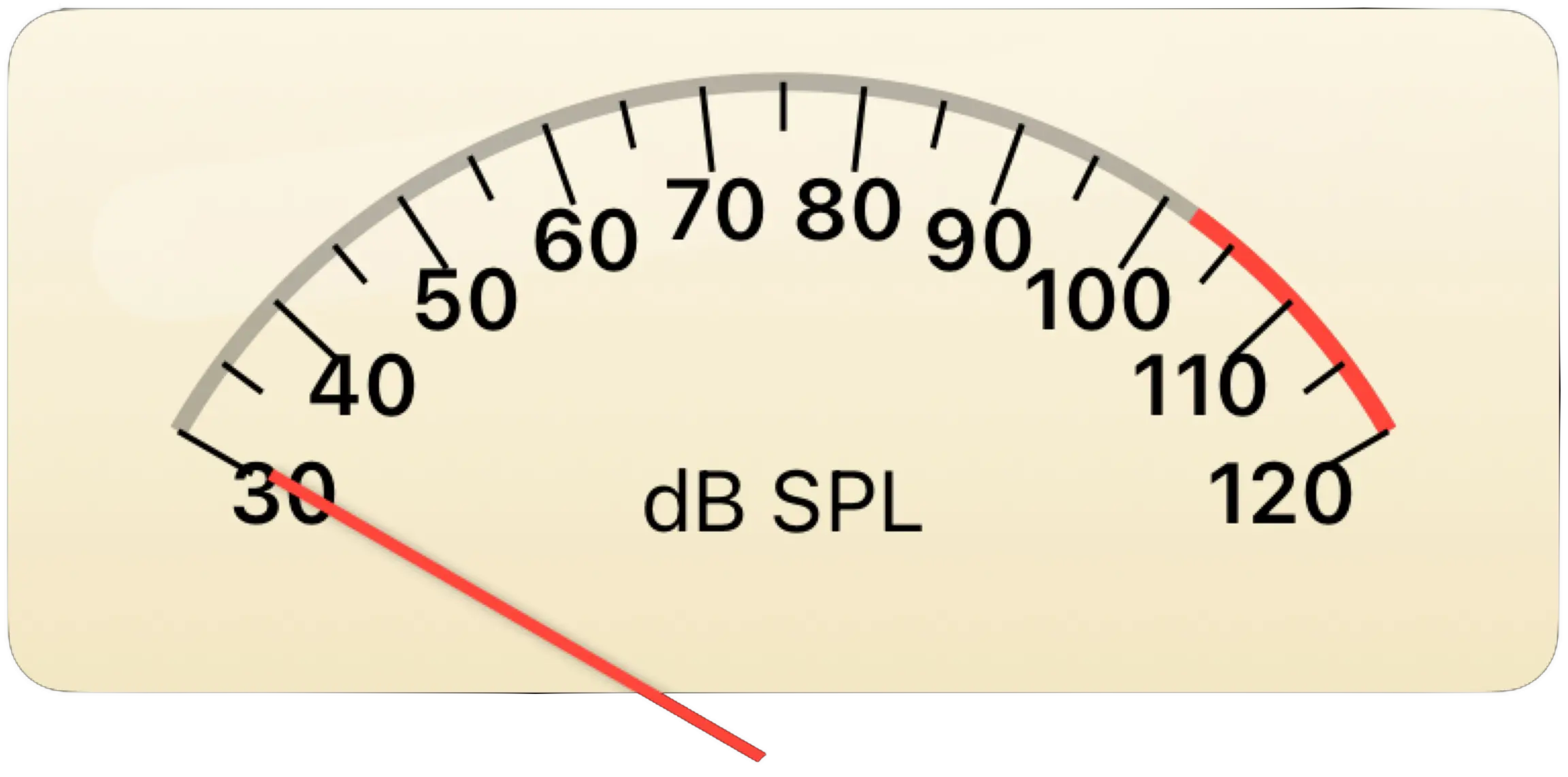
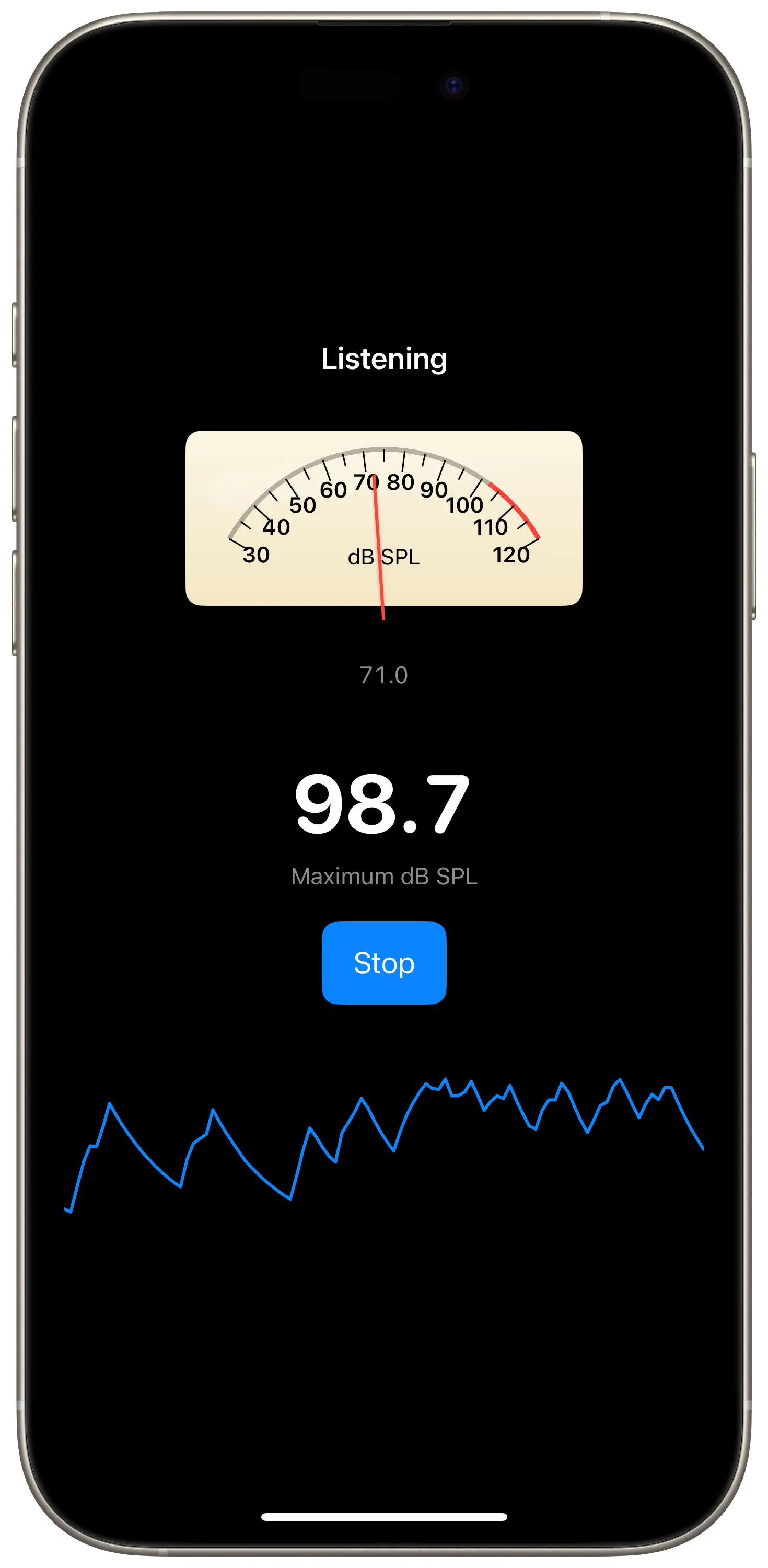
Decibels is a free sound level meter app for iPhone and iPad that gives you estimated decibel readings using your device's built in microphone. It displays levels on a vintage VU meter with smooth needle ballistics, charts your sound levels over time, and tracks peak levels automatically.
It won't replace a calibrated professional meter for safety compliance or scientific measurements. But for getting a general sense of how loud your environment is, understanding whether your office or home falls in the safe zone, or just satisfying your curiosity about the acoustic world around you, it's a useful and completely free tool.
The measurement range covers 30 to 120 dB SPL, which spans everything in the reference table above from a whisper to the threshold of pain. Open the app, hold up your phone, and see where you stand.
Find out how loud your world really is. Free, no ads, no subscriptions.